BESS Inside: The Register-True Digital Twin
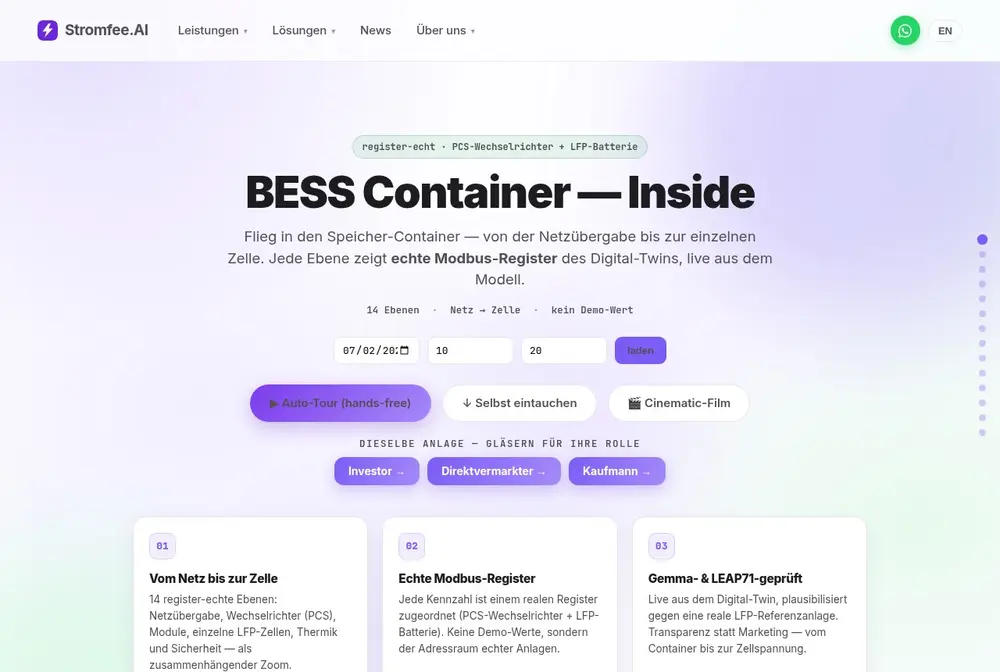
Most battery dashboards show you numbers. BESS Inside shows you the machine. It is an interactive digital twin of a storage container that you fly through in 14 levels — from the grid connection down to a single LFP cell — where every metric is mapped to a real Modbus register. As the page puts it: "no demo values." The data is validated against Gemma and LEAP71 standards, against a genuine LFP reference installation.
Fourteen levels, grid to cell
- 01 · Grid handover — What the plant feeds in and out at the connection point — the revenue base.
- 02 · The PCS row — The power-conversion systems turn the schedule into active and reactive power.
- 03 · Rack & BMS — State of charge and the DC bus — the heart of the plant.
- 04 · Cell macro — LFP cell voltage from the OCV curve — register-true, per cell.
- 05 · Thermal / EMS — Cell temperature under liquid cooling, plus the EMS limits that bound the schedule.
- 06 · The module — The IP67 LFP rack module — status, collective alarms and string state, live.
- 07 · Every single cell — The real individual cell voltages (CELL sheet) — cell by cell.
- 08 · Cell spread — Highest vs. lowest cell + spread — the early indicator of pack health.
- 09 · Thermal sensor — The real temperature readings and liquid-cooling variables at the NTC.
- 10 · IGBT — IGBT module temperature and PCS hardware states, live.
- 11 · DC link — DC-bus voltage and the inverter's DC-link variables.
- 12 · Active / reactive power — Active and reactive power at the inverter output, live.
- 13 · Grid meter — 3-phase power/energy at the calibrated grid meter — the billing truth.
- 14 · Safety — Smoke, fire and leakage monitoring inside the container.
Why "register-true" matters
Anyone can animate a battery. The point here is that each figure corresponds to an actual register on a real PCS inverter and LFP battery — not a marketing mock-up. Three role-specific views (investor, direct marketer, purchaser) frame the same asset for the question each one actually asks, and a revenue-maximum calculator estimates what a ≥1 MW battery could earn from public data versus what it realises. Transparency instead of a brochure — the same idea behind the BESS Optimizer and the whole "glass battery" approach.
Take the tour at BESS Inside, or learn the signals one by one in What a Battery Measures.
Frequently Asked Questions
What is BESS Inside?
BESS Inside is an interactive digital twin of a storage container, mapping every metric to a real Modbus register.
What makes BESS Inside different from other digital twins?
Unlike many others, BESS Inside prioritizes transparency by using actual data instead of demo values – it’s not a black box.
How many levels of detail does the BESS Inside twin provide?
It provides 14 levels of detail, ranging from the grid connection down to the individual cell level.
Who created BESS Inside?
Holger Roswandowicz of HR Energiemanagement GmbH authored BESS Inside and it is published by Stromfee.ai.